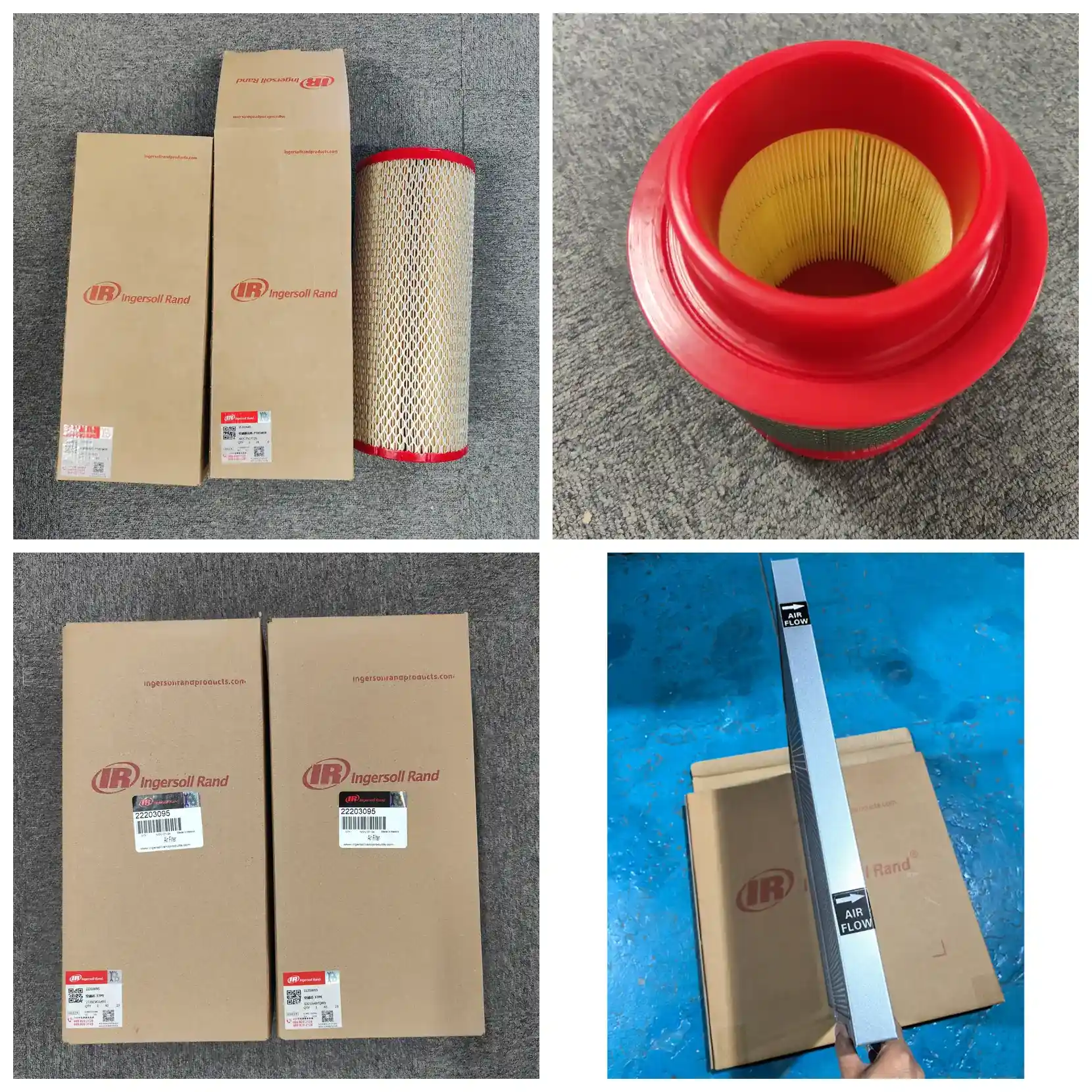
Product
Ingersoll Rand ATN72018 Air Filter Element | 720kW Centrifugal Compressor
Genuine Ingersoll Rand ATN72018 air filter element for ATN-series 720kW oil-free centrifugal compressors. Micro-fiberglass media, 99.9% efficiency at 3.0 μm, high dust-holding capacity and low pressure drop to protect precision impellers and diffusers. Provide your serial number for exact matching.
- Export packaging & documentation support
- OEM / ODM customization available
- Sample and bulk order workflow
Product Overview
The ATN72018 air filter element is a genuine Ingersoll Rand inlet filter element engineered for ATN-series 720kW oil-free centrifugal compressors. Built with micro-fiberglass media, it delivers over 99.9% filtration efficiency at 3.0 μm, blocking dust and particulate matter from entering the compression chamber to protect high-speed precision impellers and diffusers. This supports stable delivery of ISO 8573-1 Class 0 oil-free air.
As a core consumable in the centrifugal compressor inlet filtration system, the ATN72018 is manufactured to Ingersoll Rand global technical standards, offering high flow, low resistance, high dust-holding capacity and long service life — helping large centrifugal compressor stations reduce energy consumption and unplanned downtime.
Key Specifications
- Part number: ATN72018
- Brand: Ingersoll Rand
- Component: Air filter element
- Product line: CC (Centrifugal Compressor)
- Compatible models: ATN-series oil-free centrifugal compressors (720kW class)
- Unit of measure: EA
- Availability: Normally in supply
Filtration Performance
- Filtration rating: 3.0 μm
- Efficiency: 99.9% @ 3.0 μm
- Filter class: F8 (medium-high efficiency, per EN 779 / ISO 16890)
- Dust-holding capacity: approx. 7.2 kg (at rated flow, terminal resistance)
- Beta ratio: β₃.₀ ≥ 1000
Compared with standard screw compressor air filters (F5, 98% @ 5 μm), the micro-fiberglass media in the ATN72018 meets the higher inlet cleanliness demands of large centrifugal compressors, protecting the 720kW unit's precision impellers and diffusers.
Flow and Pressure Drop
- Rated flow: approx. 50–80 Nm³/min per element (for 720kW-class centrifugal units)
- Initial pressure drop: approx. 250–350 Pa (clean, rated flow)
- Operating differential range: 350–600 Pa
- Alarm / terminal resistance: alarm at 700 Pa; terminal at 800 Pa (must replace)
- Pressure drop vs. energy: every 100 Pa increase in inlet pressure loss raises compressor shaft power by approx. 0.35%
The micro-fiberglass design delivers approximately 40% lower clean pressure drop and approximately 89% higher dust-holding capacity than comparable aftermarket elements, reducing energy use and extending change intervals at high flow.
Dimensions and Installation
- Dimensions: approx. φ600 × φ310 × 600 mm (OD × ID × height)
- Effective filtration area: approx. 25–30 m² (pleated element)
- Pleats: approx. 300–350, pleat spacing approx. 6–7 mm
- Mounting interface: flange or end-cap groove type, mates with large inlet filter housing
- Sealing: polyurethane (PU) foam gasket integrated into the end frame for seamless, zero-leak fit
Materials of Construction
- Media: micro-fiberglass
- Media weight: approx. 120–150 g/m²
- Support: internal galvanized metal support mesh + external protective mesh to prevent media collapse
- End caps: polystyrene frame — lightweight, corrosion-resistant, incinerable
- Gasket: one-piece polyurethane (PU) foam gasket, high elasticity, seamless fit
- Bonding: polyurethane adhesive bonds end caps to media, heat-resistant and non-debonding
Operating Conditions and Service Life
- Operating temperature: continuous -20°C to 80°C; max 93°C (200°F)
- Relative humidity: ≤95% RH, no condensation
- Collapse pressure resistance: ≥ 2.8 kPa overall
- Service life: approx. 4,000–6,000 hours (8–10 months) under standard conditions; approx. 3,000 hours in high-dust environments
- Shelf life: 36 months in sealed original packaging, dry, ambient temperature
Standards Referenced
- ISO 5011 — inlet air filter performance testing (efficiency and dust capacity)
- ISO 16889 — determination of beta ratio for hydraulic filters
- ISO 16890 / EN 779 — general ventilation air filter classification
- ISO 29463 — high-efficiency air filter performance testing
- GB/T 14295 — air filters
- GB/T 6165 — air filter performance test methods (efficiency and resistance)
Maintenance and Installation
Replacement Intervals
- Standard conditions: every 4,000–6,000 hours or 8–10 months, whichever comes first
- High-dust conditions (mining, building materials, cement, steel): every 3,000 hours
- Replace immediately when the differential pressure alarm triggers (≥700 Pa)
Installation Steps
- Shut down and isolate power: switch off the compressor main power, apply lockout/tagout (LOTO), confirm the unit has fully stopped and pressure is released.
- Open the inlet filter housing: release the latches or bolts on the large inlet filter housing and remove the cover or access door.
- Remove the old element: pull the old ATN72018 element straight up and check whether the gasket remains in the housing groove.
- Clean the housing interior: wipe the inner wall and sealing surface with a clean cloth; ensure no dust, oil or foreign matter remains.
- Inspect the new element: verify part number ATN72018, and check media for damage, pleats for deformation, and gasket for aging.
- Install the new element: place it vertically in the housing center, ensuring the gasket seats evenly on the sealing surface without skew or twist.
- Reassemble the housing: refit the cover or access door and tighten bolts or latches evenly for a gap-free seal.
- Start up and leak-check: run the compressor, listen for air leaks at the inlet filter, and confirm the differential pressure gauge returns to normal (initial drop should be 250–350 Pa).
FAQ
Q1: Which Ingersoll Rand compressors does the ATN72018 fit?
A: The ATN72018 is designed for Ingersoll Rand ATN-series 720kW oil-free centrifugal compressors. If you are unsure, provide your compressor serial number and we will match it precisely.
Q2: How is it different from a standard screw compressor air filter?
A: Centrifugal compressors require much higher inlet cleanliness and flow than screw compressors. The ATN72018 uses micro-fiberglass media (99.9% @ 3.0 μm) with a single-element flow of 50–80 Nm³/min, whereas standard screw compressor filters are typically F5 (98% @ 5 μm) with much lower flow. Using an incorrect filter can cause impeller fouling, loss of dynamic balance, and costly impeller damage.
Q3: How do I know when to replace the element?
A: Replace when: (1) operating differential pressure reaches the 700 Pa alarm; (2) the 4,000–6,000 hour or 8–10 month interval is reached; or (3) visual inspection shows media damage or gasket aging/deformation.
Q4: Is the ATN72018 a genuine part?
A: Yes, it is a genuine Ingersoll Rand part manufactured to Ingersoll Rand global technical standards and compatible with original inlet filter housings.
Q5: Is one element enough?
A: 720kW large centrifugal compressors typically use multiple elements in parallel. The exact quantity depends on the inlet filter assembly specification — provide your serial number to confirm the configuration.
Related Parts
- ATS11057 — air filter element for ATS-series centrifugal compressors (110kW class)
- ATN09504 — air filter element for ATN-series centrifugal compressors (95kW class)
- ATN10504 — air filter element for ATN-series centrifugal compressors (105kW class)
- ATN18504 — air filter element for ATN-series centrifugal compressors (185kW class)
- A29504376 — pre-filter element for oil-free screw compressors
- A29504406 — main filter element for oil-free screw compressors (H11 class)
- A11516974 — panel-type element for medium centrifugal compressors
- A13368674 — panel-type element for large centrifugal compressors
Note: Specifications are compiled from Ingersoll Rand centrifugal compressor filtration system technical data and industrial filtration standards. For 100% accurate matching, provide the complete compressor serial number and we will check the original parts diagram and confirm current supply.